Eland (Taurotragus oryx)

Details

Details of Eland (Taurotragus oryx)

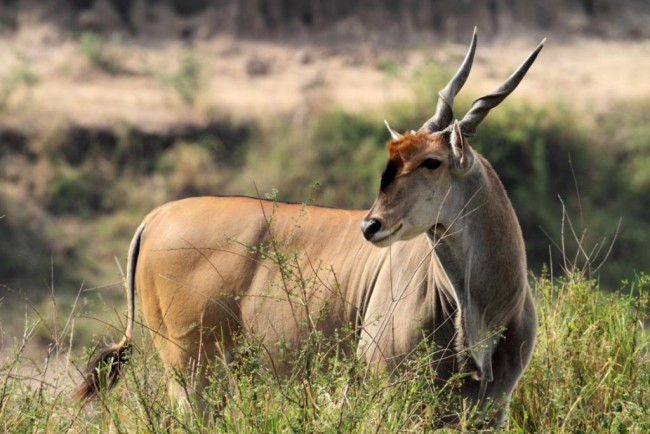
The largest living antelope along with the giant eland. Older bulls develop a large pendulous dewlap on the throat and a distinctive mat of fairly long, coarse dark hair on the forehead. A short dark mane runs down the back of the neck of both sexes.

Both carry shallowly spiraled horns, with those of the bull more robust and distinctly ridged along their length. Overall body colour is usually fawn or tawny, with forequarters in particular turning blue grey with age. Like the giant eland some white vertical striping may be present but not as pronounced.

They normally form herds of from 25 to 60 animals but on occasion congregations of 1000 or more individuals occur, particularly during the onset and through the course of rains. Their highly nomadic in most parts of their range but some populations appears to be more sedentary.

Home ranges are generally large, covering 1500 km square for mixed herds in one East African study but only 25 to 100 km square for the adults bulls.

The eland is a shy animal, and will escape in a hurry whenever it feels threatened.

Short Overview

Height: M 170 cm; F 145 cm


Weight: M 800 kg; F 480 kg


Active: Mainly diurnal


Habitat: Varied from open plains to mountains to semi desert


Food: Mainly leaves, fruit, also grass in summer

Let us plan your dream
African trip!

Rainy Season in Tanzania doesn't always mean cancelled plans and flooded roads; some showers blow through in minutes. However, some can mess with your driving or getting to a remote camp. The difference comes down to the month, the region, and how ready you've made yourself. Think of this as...
Kenya's Safari story usually gets told through the Maasai Mara, Amboseli, and the Big Five. However, beyond those famous names there are mountain forests, flamingo-covered lakes, dry northern reserves, conservation projects, and gorges. You can actually walk through on foot on these gorges. That's where an Off-Beat Kenya Safari comes...
A first Kenya Safari usually centres on the big names. For instance, lions, elephants, the Maasai Mara and the excitement of seeing everything for the first time. A second trip feels different. There's less pressure to complete a checklist. There's more room to notice the small stuff: how a herd...
A Hadzabe Tribe Visit Tanzania gets sold on almost every Lake Eyasi itinerary, a dawn hunt, the click sounds of the language, arrows and honey. What most travellers never learn is how much of what they saw was arranged in advance for them to see. This blog explains who the...
Most first safaris get built around a fear of missing out, six parks, six days, a new lodge every night. What you get is a holiday spent mostly in transit, watching Tanzania slide past through a window. A Slow Safari Tanzania flips that. Fewer parks, more nights, deeper time with...